

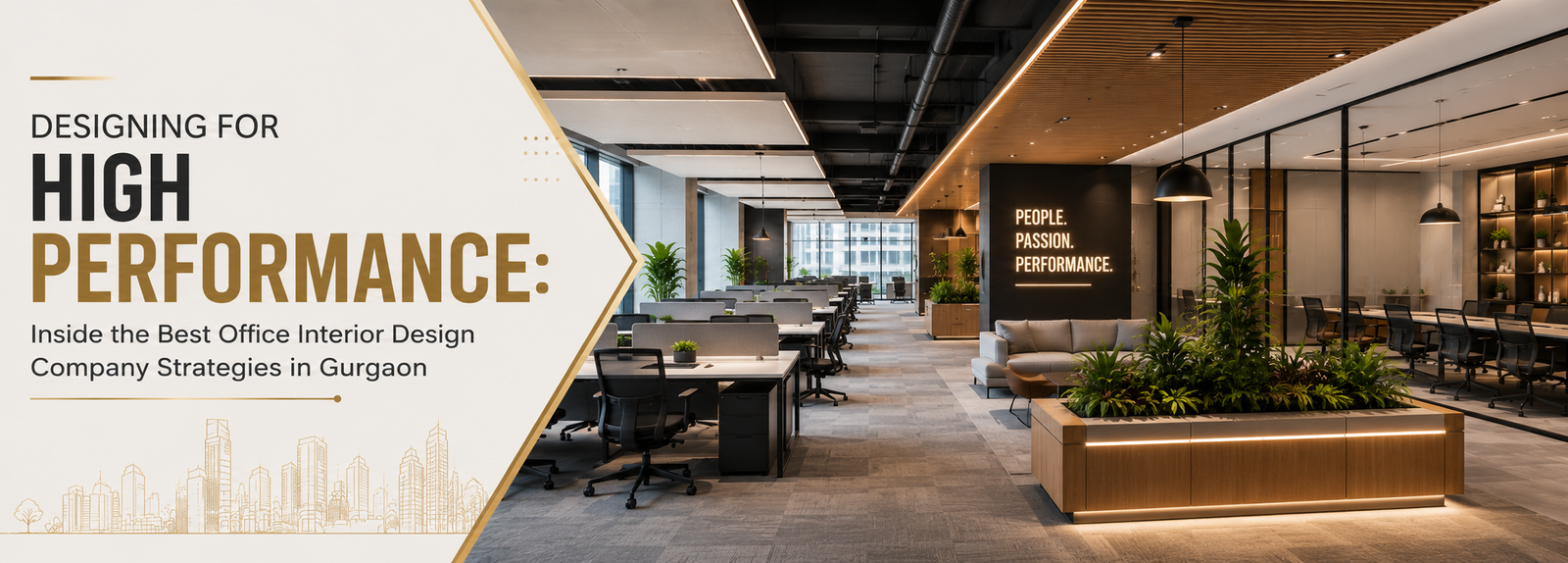
Designing for High Performance: Inside the Best Office Interior Design Company Strategies in Gurgaon
Walk into the average Gurgaon office built before 2015 and you find the same thing: dropped ceilings at 2.7 metres, a single fluorescent lighting circuit, an open floor plan optimised for density, and a glass-walled conference room with zero acoustic treatment. These offices were built for headcount not for work.
The best office interior design firms operating in Gurgaon today are working from a different premise entirely. For GCCs, tech firms, and professional services companies along Cyber City, Horizon Center, and Golf Course Road, the office has become a competitive asset one that directly affects recruiting, retention, and how the company reads to every global visitor who walks through the door.
From Cubicles to Destination Offices: The New Corporate Workspace Paradigm
A destination office gives employees a reason to come in that a home office cannot replicate and creates the conditions for work that distributed teams genuinely struggle to do: spontaneous collaboration, mentoring, cultural cohesion.
This shift has measurable business outcomes:
- Well-designed offices are linked to higher engagement, lower cognitive fatigue, and better collaboration quality
- Poorly designed open-plan environments loud, over-lit, thermally inconsistent drive presenteeism, burnout, and voluntary attrition
- For Gurgaon GCCs specifically, an office that cannot retain senior technical talent attracts scrutiny from global HQ
What “Destination” Actually Means in Practice
It is not a lobby that looks like a hotel. It is a workspace where:
- Focused individual work happens in genuinely quiet areas
- Collaboration spaces are appropriately stimulating not acoustically chaotic
- The cafeteria is worth the walk
- The overall daily experience adds something a kitchen table cannot
Spatial Psychology & Ergonomic Flow: How Design Drives Employee Retention
How a space is arranged affects how people think, move, and feel in it. This is not abstract it has specific, practical implications for office design.
Key principles:
- Ceiling height affects cognition above 3m encourages expansive, creative thinking; standard heights suit detail-focused, procedural work. Use this deliberately by zone
- Movement reduces fatigue a layout that builds natural walking between zones keeps cognition sharper through the day; sedentary workers in fixed positions for 4+ hours show measurable output decline
- Visual variety matters unbroken rows of identical workstations create monotony that compounds mental exhaustion; varied zones, textures, and sightlines provide necessary cognitive rest
Biophilic Zones as Retention Environments
Spaces with natural materials, living planting, and daylight access consistently rank as preferred across workforce demographics. In competitive talent markets, this preference has real commercial weight.
Effective biophilic installations solve multiple problems at once:
- Planted screens that provide acoustic separation while improving air quality
- North-facing skylights that bring daylight into internal zones while managing heat gain
- Natural stone and timber feature walls that add acoustic mass while creating zone identity
Acoustic Engineering & Privacy Pods for Hybrid Work Environments
Acoustic performance is the most underinvested and highest-impact dimension of office design in India. It is also the most expensive to correct after construction.
Hybrid work creates a specific new acoustic problem: a person on a video call in open plan creates a noise event for those around them while simultaneously trying to hear a remote participant. Solving this requires more than a few phone booths.
The layered acoustic approach:
- Room-level specification every meeting room needs acoustic treatment calibrated to its size and use type; a six-person video room has different reverb requirements than a 20-person town hall
- Floor-plate acoustic zoning divide the plan into zones with engineering targets:
- Focus zones: below 45 dB ambient
- Collaboration zones: up to 60 dB acceptable
- Transition buffer zones between them
- HVAC acoustic management the most common noise source in open-plan offices is the HVAC system; duct sizing, fan spec, and diffuser placement must be coordinated with interior design from the start, not resolved on site
Privacy Pods: What Works and What Doesn’t
A properly specified pod must:
- Achieve 30+ dB sound reduction in both directions
- Have adequate ventilation for occupancy beyond 20 minutes
- Include power and connectivity to function as a real work environment
Gurgaon-specific issue: Pods without integrated HVAC cooling become unusable within minutes in summer. Most European pod specifications do not account for this. Verify thermal performance before procurement.
IGBC Green Standards & Biophilic Installations as Natural Air-Purifiers
IGBC-aligned design is increasingly a client requirement not an optional add-on for GCCs reporting to global ESG frameworks. It also has direct operational benefits that matter regardless of certification.
Air quality is the most immediate of these. Delhi-NCR air quality is a genuine occupational health concern. An IGBC-compliant fit-out will typically include:
- MERV-13 or equivalent filtration
- CO₂ monitoring with automatic fresh air adjustment
- Low-VOC finishes and adhesives throughout
Living walls and planted zones when properly lit and maintained deliver:
- Measurable reduction in VOC levels
- Improved relative humidity in dry winter months
- Reduced CO₂ concentration in enclosed zones
- Acoustic absorption (a productive side effect of mass and texture)
What IGBC Certification Requires in a Fit-Out
Documentation across five categories:
- Energy performance lighting power density, HVAC efficiency
- Water efficiency fixtures and landscape
- Indoor environmental quality air quality, daylight, acoustics
- Materials recycled content, regional sourcing, low-emission spec
- Innovation credits project-specific sustainability strategies
The documentation burden is real. Firms with prior certification experience capture this information during design rather than reconstructing it afterward which significantly reduces the time and cost of achieving certification.
Traditional Office Layouts vs. Next-Gen Hybrid Workspaces
Dimension | Traditional Layout | Next-Gen Hybrid Workspace |
Design objective | Seat count per sq m | Output per person per day |
Acoustics | Incidental | Engineered by zone from day one |
Lighting | Single-circuit overhead fluorescent | Layered: ambient + task + feature; tunable colour temperature |
Meeting rooms | Enclosed, uniform size, glass walls | Varied: focus rooms, video rooms, town hall, informal nodes |
Collaboration | Boardroom | Standing tables, lounge clusters, project rooms, whiteboard alcoves |
Individual focus | Open desk in open plan | Quiet zones + bookable focus rooms |
Biophilic elements | Occasional potted plant | Integrated: living walls, planted screens, daylit zones |
Air quality | Standard HVAC | Monitored IAQ, CO₂ response, MERV-13 filtration |
Flexibility | Fixed layout | Modular furniture, movable partitions, future-proofed power/data |
ESG credentials | Not considered | IGBC-aligned spec, low-VOC finishes, recycled content targets |
Conclusion
The most expensive office outcome in Gurgaon is building something that needs remediation within three years acoustic panels covering what should have been a treated ceiling from the start, imported privacy pods fixing an open-plan that was never properly zoned, HVAC replacements driven by a mechanical system that was never coordinated with the interior design.
The offices that avoid this started with a more demanding brief. They asked what the space needs to do for recruiting, retention, and the specific cognitive work their teams perform before asking what it should look like. Then they hired an office interior design company with the technical competence to actually deliver it.
Arch Blue Atelier brings integrated architecture, interior design, and workplace strategy to commercial clients across Cyber City, Horizon Center, Golf Course Road, and Gurgaon’s emerging commercial corridors. Contact the studio to discuss your project.
Frequently Asked Questions
What does an office fit-out cost per sq ft in Gurgaon?
GCC-grade offices with full acoustic engineering, biophilic elements, and IGBC-aligned spec typically range from ₹3,500 to ₹8,000 per sq ft. Budget fit-outs that cut acoustic and MEP coordination often require remedial spend within two to three years.
How long does a Gurgaon office fit-out take?
A 10,000–30,000 sq ft fit-out typically takes 16–24 weeks from design brief to completion. IGBC documentation runs in parallel and does not extend the construction timeline.
What acoustic standards should a high-performance office achieve?
Focus zones: below 45 dB ambient. Collaboration zones: 50–55 dB. Enclosed meeting rooms: NRC 0.8+, reverb time 0.3–0.6 seconds. Privacy pods: 30+ dB sound reduction. These are engineering targets, not guidelines.
What sustainability trends matter most in Indian corporate offices right now?
Three are driving decisions: IGBC/LEED CI certification as a client requirement (not optional), monitored indoor air quality as standard (driven by NCR conditions and post-pandemic wellness awareness), and circular procurement specifying furniture and finishes with documented end-of-life pathways.
How do we choose the right office interior design company for a GCC project?
Evaluate on: acoustic engineering competence (ask for post-occupancy data), IGBC documentation experience, technology integration capability (AV, hot-desking, room booking integrated into design, not handled separately), and whether the firm conducts post-occupancy reviews. Firms that return to measure performance 3–6 months after handover have a different relationship with quality than those that don't.
About the Author
Ar. Anurag Pandey is the Founder & CMD of ArchBlue Atelier. With expertise in architecture, interior design, and project execution, he is passionate about creating spaces that combine functionality, innovation, and timeless aesthetics. Through these articles, he shares practical insights, industry trends, and expert advice to help readers navigate the world of architecture and design.

Leave a Reply